
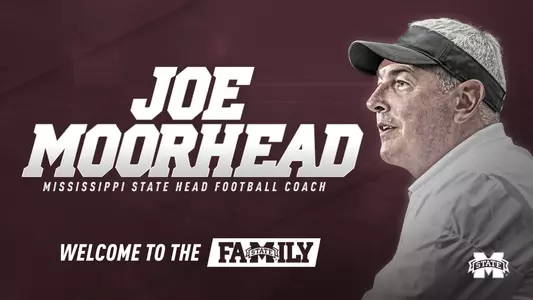
HAILSTATEBEAT: Q&A With New Football Coach Joe Moorhead
November 29, 2017 | HailStateBEAT
HailStateBEAT
On Wednesday morning, Mississippi State announced Joe Moorhead as its new head football coach, and on Wednesday afternoon, the innovative coordinator behind Penn State's offensive explosion the last two seasons touched down in Starkville to be officially welcomed as a Bulldog. Joined by his wife Jennifer, their daughter Kyra and their two sons Mason and Donovan, Moorhead was welcomed by a crowd of over 1,000 at Bryan Airfield.
Shortly after arrival, Moorhead sat down for a few minutes with HailStateBEAT reporter Bob Carskadon to talk about his new job, his philosophy on coaching and a handful of other topics. The following is a transcript of that conversation. For more from Moorhead and his arrival, follow @HailStateFB on Twitter and Facebook.
----------------------
Bob Carskadon: So, I'll start with the obvious question here. You've had opportunities to take other jobs before and didn't. Why Mississippi State?
Joe Moorhead: It checked off all the boxes. When considering opportunities, there are three criteria: personal, professional and monetary. For myself and my family, the Mississippi State and Starkville community seemed like an awesome opportunity. Professionally, it's the opportunity to lead a team in the most competitive conference in the country. Monetarily, I'm able to set my family up for a type of lifestyle I could have never dreamed of as a kid growing up. Those three things combined just made it special.
BC: I've read a ton about you since your name came up, all about your offensive prowess and innovation and success. My question is, how do you take something so complicated and boil it down to a point where 18-22 year olds can pick up on it quickly?
JM: Well, I kind of look at it this way: there are three criteria we talk about as an offensive coaching staff, relative to our scheme. Is it sound, can we teach it, and can the players execute it? If it doesn't fit one of those three then we don't use it. We don't want to do a million different things and major in the minors. We want to pick out the things that we do successfully and make it, with window dressing, look a little more complicated than it actually is. Our simplicity and flexibility combined with our players' culture, work ethic, discipline and talent, has made us a pretty special offense the past couple years.
BC: On the other side of the ball, is there a particular defensive philosophy or scheme you prefer?
JM: No, I want our entire program to have an attacking philosophy. We're not going to be a team in any phase of the game – offense, defense, special teams – where we're going to sit back and let someone dictate the game to us. We're going to attack on offense, attack on defense, and we'll get after it on special teams. Now, obviously, everything in moderation. You can't blitz every single play, but we're going to be a team that's going to get after it physically and not let the quarterback get comfortable, and get 11 hats to the ball.
BC: Well, that answers my next question, which was going to be about your general approach and team philosophy. Let's move to recruiting. Obviously, you're going to look for talented players – big, fast, strong, all that. But what are some of the intangible characteristics you look for in recruiting?
JM: The first thing you look at is, does the player possess the athletic and football ability to help Mississippi State win an SEC Championship and compete for a National Championship. After that, I'm a believer in the intangibles and how they manifest themselves on the field. We want kids that are smart, tough, disciplined, possess a great work ethic and care about team success more than individual recognition. The three things that I think are imperative to success: talent, culture and coaching. Recruit a roster full of talented kids who do things the right way, put them in a culture that's going to demand accountability, productivity and persistence, then through scheme put them in a position to be successful. I think that's the recipe for success.
BC: I'll ask one last question to finish up, and we'll get away from football on this one. In the little free time you have away from coaching, recruiting, studying and everything else that goes with the job, how do you spend your time? What things do you enjoy doing?
JM: I enjoy watching TV, particularly reality TV. My latest thing is the History Channel. I've been on an American Pickers kick. Been watching a lot of Oak Island, a lot of Pawn Stars. Then we have shows we watch as a family. Then usually if I'm not here, I'm at one of their games or practices hanging out with them. I stink at golf. I'd love to fish if I had more time. But yeah, we're watching TV or out playing ball.
Shortly after arrival, Moorhead sat down for a few minutes with HailStateBEAT reporter Bob Carskadon to talk about his new job, his philosophy on coaching and a handful of other topics. The following is a transcript of that conversation. For more from Moorhead and his arrival, follow @HailStateFB on Twitter and Facebook.
----------------------
Bob Carskadon: So, I'll start with the obvious question here. You've had opportunities to take other jobs before and didn't. Why Mississippi State?
Joe Moorhead: It checked off all the boxes. When considering opportunities, there are three criteria: personal, professional and monetary. For myself and my family, the Mississippi State and Starkville community seemed like an awesome opportunity. Professionally, it's the opportunity to lead a team in the most competitive conference in the country. Monetarily, I'm able to set my family up for a type of lifestyle I could have never dreamed of as a kid growing up. Those three things combined just made it special.
BC: I've read a ton about you since your name came up, all about your offensive prowess and innovation and success. My question is, how do you take something so complicated and boil it down to a point where 18-22 year olds can pick up on it quickly?
JM: Well, I kind of look at it this way: there are three criteria we talk about as an offensive coaching staff, relative to our scheme. Is it sound, can we teach it, and can the players execute it? If it doesn't fit one of those three then we don't use it. We don't want to do a million different things and major in the minors. We want to pick out the things that we do successfully and make it, with window dressing, look a little more complicated than it actually is. Our simplicity and flexibility combined with our players' culture, work ethic, discipline and talent, has made us a pretty special offense the past couple years.
BC: On the other side of the ball, is there a particular defensive philosophy or scheme you prefer?
JM: No, I want our entire program to have an attacking philosophy. We're not going to be a team in any phase of the game – offense, defense, special teams – where we're going to sit back and let someone dictate the game to us. We're going to attack on offense, attack on defense, and we'll get after it on special teams. Now, obviously, everything in moderation. You can't blitz every single play, but we're going to be a team that's going to get after it physically and not let the quarterback get comfortable, and get 11 hats to the ball.
BC: Well, that answers my next question, which was going to be about your general approach and team philosophy. Let's move to recruiting. Obviously, you're going to look for talented players – big, fast, strong, all that. But what are some of the intangible characteristics you look for in recruiting?
JM: The first thing you look at is, does the player possess the athletic and football ability to help Mississippi State win an SEC Championship and compete for a National Championship. After that, I'm a believer in the intangibles and how they manifest themselves on the field. We want kids that are smart, tough, disciplined, possess a great work ethic and care about team success more than individual recognition. The three things that I think are imperative to success: talent, culture and coaching. Recruit a roster full of talented kids who do things the right way, put them in a culture that's going to demand accountability, productivity and persistence, then through scheme put them in a position to be successful. I think that's the recipe for success.
BC: I'll ask one last question to finish up, and we'll get away from football on this one. In the little free time you have away from coaching, recruiting, studying and everything else that goes with the job, how do you spend your time? What things do you enjoy doing?
JM: I enjoy watching TV, particularly reality TV. My latest thing is the History Channel. I've been on an American Pickers kick. Been watching a lot of Oak Island, a lot of Pawn Stars. Then we have shows we watch as a family. Then usually if I'm not here, I'm at one of their games or practices hanging out with them. I stink at golf. I'd love to fish if I had more time. But yeah, we're watching TV or out playing ball.

BASEBALL | NCAA Starkville Highlights vs. Cincinnati - 5/30/26
Sunday, May 31
BASEBALL | Brian O'Connor, Reed Stallman & Tomas Valincius Cincinnati Postgame Press Conference - 5/30/26
Sunday, May 31
BASEBALL | NCAA Starkville Highlights vs. Lipscomb - 5/29/26
Saturday, May 30
SOFTBALL | Postgame Press Conference vs Texas (WCWS) 5/29/26
Friday, May 29