Air Raid Catching On Quicker Than Ever
November 23, 2021 | Football, Joel Coleman
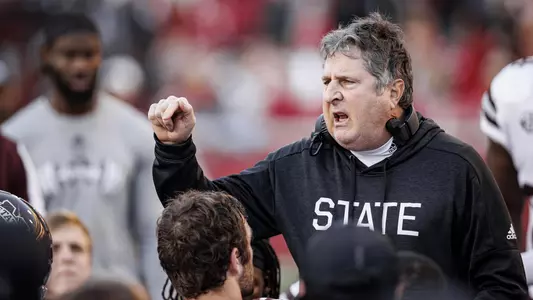
Mike Leach has never had a year two quite as good as this one.
STARKVILLE – It wasn't all that long ago, pundits were asking, 'Can the Air Raid work in the Southeastern Conference?'
The question has since changed. Now, it's, 'Just how high can it fly?'
Mississippi State head coach Mike Leach's offensive system has taken off in Starkville. Now, for those who have followed Leach throughout his career, it shouldn't come as much of a surprise that he's seeing progress in his second year with a team. He's done it before, but never quite like this.
Almost across the board, this so far has been the biggest year one to year two jump in any of Leach's three career head coaching stops. Let's take a quick glance at how this season at MSU compares to Leach's second years at Texas Tech and Washington State:
- From 2000 to 2001 at Texas Tech, the Red Raiders increased their passing yardage per game by 41.6 yards, their rushing yardage per game by 15 yards and their total yardage per game by 56.6 yards. Texas Tech increased its scoring by 8.1 points per game.
- From 2012 to 2013 at Washington State, the Cougars increased their passing yardage per game by 37.6 yards, their rushing yardage per game by 24.3 yards and their total yardage per game by 61.9 yards. Washington State increased its scoring by 10.6 points per game.
- From last year to this year at Mississippi State, the Bulldogs have increased their passing yardage by 93.9 yards per game, their rushing yardage by 18.2 yards per game and their total yardage by a whopping 112.1 yards per game. MSU has increased its scoring by 10.4 points per game.
So by passing yardage, Leach's year two in Maroon and White has more than doubled his previous best year one to year two progression. In fact, you could add up Texas Tech and Washington State's year one to year two passing yardage per game averages, and it still wouldn't eclipse MSU's 93.9 yards per game increase.
State's tremendous jump in the passing game from last year to this year is of course responsible for the 112.1-yard increase in total yardage per contest. Leach surely enjoyed his 61.9 total yards per game increase from 2012 to 2013 at Washington State (the previous high), but it paled in comparison to how this year's Bulldogs have leaped forward.
It's no big secret that central to Mississippi State's progression this year has been the development of quarterback Will Rogers. The sophomore signal caller (who, by the way, still has three years of eligibility left beyond this one to further refine his skills) is rewriting the MSU record book by the week.
He's already State's single-season record holder for passing yardage (4,113) and touchdowns (34), both numbers that'll surely increase with Thursday's game against Ole Miss and a bowl game still to come. Rogers leads the SEC and all of Power Five football in passing yardage and is only the seventh SEC quarterback to ever pass for 4,000-plus yards in a single year.
So how has this young guy, who was playing high school football at this time just two years ago, become a premier pilot for the Air Raid? Yes, the experience Rogers has gained from week to week since last season is part of it, but what else?
"His dad is a football coach and an offensive football coach, so I am sure he picked up a lot from his dad," Leach said of Rogers. "He's a real good worker. He works like crazy. He watches and studies film."
Leach goes on to explain what is arguably the biggest key of all. For all the work Rogers puts in, it's perhaps his attitude that has helped make him special. He stepped into a starting role as a true freshman midway through 2020 and hasn't flinched since.
"He wasn't afraid to step in and be the leader and be the quarterback," Leach said. "It's not like he took some long period where he had to overcome his own nerves or anxiety or something. He was ready to step in there and play right away."
Rogers, understandably, experienced some early turbulence last season and in the beginning stages of this year. All the while though, Rogers was soaking everything in, growing in confidence and knowledge. It's perhaps cliché to say, but the game seemingly slowed down for Rogers with each passing contest.
And as Leach points out, Rogers has gotten help.
"The other thing is the people around him have improved," Leach said. "So, that has helped make [Rogers'] job easier and help him elevate."
MSU's offensive line has become a stable, strong unit. State has the nation's No. 5 pass blocking grade per Pro Football Focus, and the Bulldogs have allowed the fourth-fewest tackles for loss in the SEC this season.
The Bulldog running backs are threats both on the ground and through the air. Jo'quavious Marks is second on the team in receptions. Dillon Johnson leads the team in runs of 20-plus yards and is third in receptions.
At receiver, Makai Polk, Jaden Walley and Austin Williams give MSU three pass catchers with more than 500 yards of receiving for the very first time in program history. Additionally, State is one of only 10 teams in the nation with 10 players that have 10 or more catches. Six Bulldogs boast streaks of 10 or more consecutive games with a reception.
So, the colossal improvement of the MSU Air Raid in year two under Leach isn't some one-man show. It's a collective effort from everyone. From seniors to freshmen, down to even a couple of walk-ons who have since earned scholarships – it's a team effort.
The Bulldogs are all flying high. With the veteran Leach at the helm, it's a safe bet MSU will continue gaining altitude. First things first though.
On Thanksgiving night against the instate rival Rebels, the Bulldogs get their next chance to elevate. Leach has never had an eight-win season within his first two years at any school. For all the second-year statistics he's topped this year, setting a new benchmark in the victories department would surely be the sweetest of all.